
The right kind of fire: building our landscapes’ resilience
Feathery-soft cool ash sits in my palm, disintegrating as it falls through my fingers.
It was part of the lantana (Lantana camara) on fire not long ago, but now as it returns to the ground it will become a cover for regenerating species.
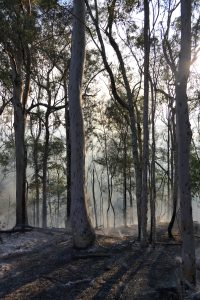
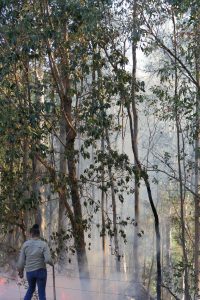
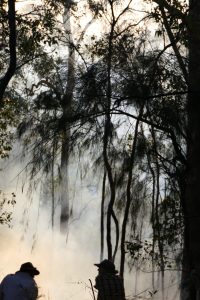
Around me, a haze rises through the canopy, thin, pale clouds that are backlit by the sun. The fire itself is almost unremarkable. It moves low and slow through the grass and leaf litter. It leaves small unburnt patches in its wake. All you hear is a low crackle, a soft collapse as stems give way, and the birds chittering, with the faint smell of smoke into the morning air.
We walk with the fire.
A few metres ahead, the group pauses, watching the line as it creeps forward. Someone points to a section where the flame has dropped, where it has run out of fuel and begun to extinguish itself. There is no urgency, no raised voices. Just quiet discussion on how it’s tracking, how it’s behaving, and what the plan is next.
It feels, above all, controlled.
This is a cool ecological burn, carried out on a private property tucked into the hills in the Gold Coast hinterland.
The landscape hasn’t always looked like this.
Two days ago, the landholder tells me, they couldn’t walk through here. Lantana had taken hold—dense, thorny thickets that knitted themselves into something close to impenetrable. It smothers everything beneath it, outcompetes native plants, and reshapes the forest structure from the ground up. Introduced as a garden plant and let loose roughly 185 years ago, lantana currently infests more than four million hectares of land across Australia. Lantana camara is listed by the Australian Government as a ‘destructive weed of national significance’ and is regarded to be in the top 100 of the world’s worst invasive alien species by the Global Invasive Species Database.
“You’re never going to win, and there’ll always be something to do,” the landholder says, looking out over the now open understory. “But you can get it to a point where you’re happy with it, where the forests’ resilience starts to win and dominate again.”
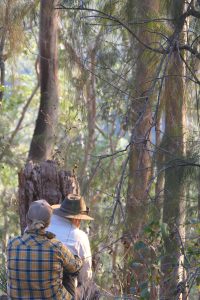
Growing up on the property and looking after it, landholder Catherine has weathered changes in the condition of the land. Over the last 17 years, Catherine and Dave have worked hard at reducing lantana infestation across the property. With integrated weed management techniques, they returned again and again as new growth pushed through. Slowly, the balance shifted. Lantana thickets turned into small patches.
And then, a superstorm for a 2023 Christmas present.
It tore through the property, opening and disturbing the balance of shade given by the canopy, allowing the weeds to thrive. Within two very wet years, the lantana was back: waist-high, dense, fast-growing and reclaiming ground that had taken over a decade to recover.
In wet years especially, lantana doesn’t just return. It surges. Even when actively working to manage lantana, you’d be lucky to keep it at its current density, let alone reduce it. “It was blindingly apparent that the forest needed something more, with its resilience broken, a natural force to tip the balance back on a larger, more holistic scale,” says Dave.
Expanding lantana in the landscape changes more than just what you see. It changes how fire behaves when it meets it.
Lantana builds fuel for fire: it’s thick, continuous, and woody once conditions dry out. It promotes more intense wildfires that carry flames higher into the canopy, burns hotter, and more completely. Under the wrong conditions—unplanned, high fuel load, hot, dry, windy—fire stops being something you can walk beside, and becomes the wildfires we have been all too familiar with in recent years.
Which is why ecological burns like this are so carefully timed and risk managed. Their effective execution requires intrinsic knowledge of diverse natural systems and their individual ecology, which often changes dozens of times across sites.
Across much of Australia, ecosystems evolved with fire. Not the uncontrollable kind that dominates headlines, but low-intensity, controlled burns that move in patterns, leaving behind a mosaic of burnt and unburnt ground. Indigenous peoples’ fire management have shaped the landscape for millennia and is still: lighting, guiding, and reading fire.
Fire is used for different purposes and there is no single way to burn. For some ecosystems, the right decision is no fire and not to burn at all. But here, today, the method is mosaic—roughly eighty percent burnt, twenty percent left untouched—for a 22-hectare patch among many hundreds of hectares. It’s the first fire back in the landscape in over 35 years.
The fire moves slowly enough to allow insects, reptiles, and small mammals to move ahead of it. It leaves refuges of unburnt patches where life can persist and return from.
What stands out here is not just the fire, but the way it is being used. Not as a last resort, but as a tool that is applied carefully and deliberately, with an understanding built over millennia thanks to Indigenous fire management and a landholder attuned to the changes in their properties’ wellbeing and methods to reinstate its health.
The result is a beautifully checkered landscape between the trees.
At one point, I stop and look up.
Flying foxes hang in the gum trees overhead, shifting slightly as smoke threads past them. Some are awake, foraging and feeding as the fire moves below. The scene feels improbable, fire on the ground and life carrying on above it, but this is precisely the point. The burn is doing what it is meant to do: moving through the landscape without overwhelming it.
Yesterday the Jagun Alliance team worked steadily along the slope, blacking out the top edge of the burn. Along the top of the hill, they extinguished sections deliberately, creating a buffer—a place where, even if conditions shift, the fire will stop. It’s careful, deliberate work, shaped as much by experience as by planning.
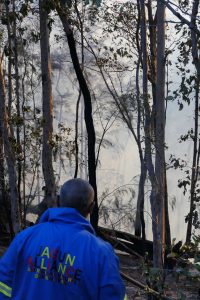
Planned burning like this, now, comes with added constraints. New permits, coordination with fire authorities, and registering times all narrow the agility to respond to potential burning times. With fuel loads higher than they once were and increasingly fluctuating weather, the window for good fire becomes smaller still.
You have to get it right.
In saying that, we also have added tools now to support good fire: water tanks for utes, rake hoes, drip torches, and leaf blowers. By the end of the day, the 22 hectares have been burnt.
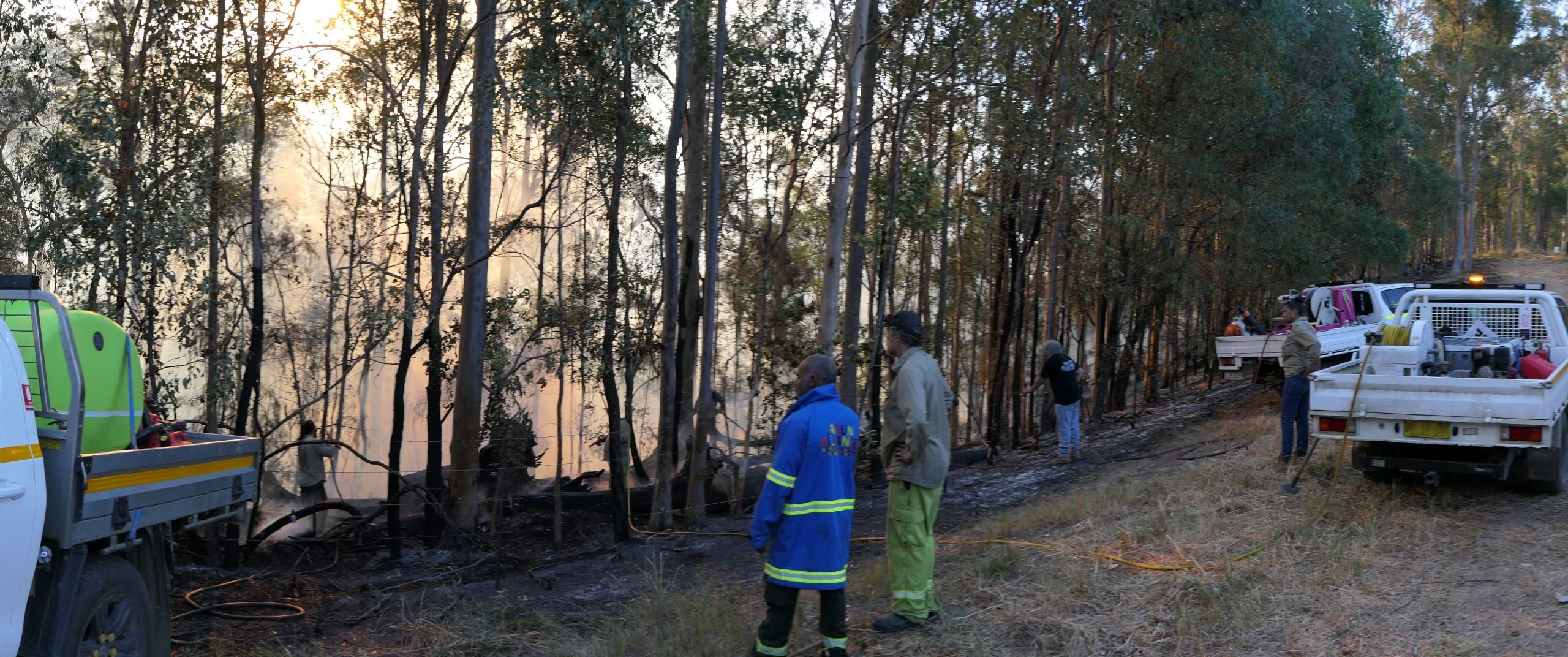
As I head home, you can see the fire has left behind a changed landscape. Unencumbered. The area that was once dense and difficult to move through is now easily walkable. The ground is visible. Later, the group followed the slope all the way down to the creek, a path that would have been blocked just hours before. At the base, the fire has done what it should in these conditions: fragmented, slowed, and finally extinguished itself.
In the weeks that follow, Catherine and Dave begin to see other changes.
Movement through the landscape is easier again, for people and wildlife. With the opened understory, lantana and weedy vines can be spot-treated, making it much more targeted and manageable. Their camera traps pick up increased activity: kangaroos bounding in, frogs hopping along, and koalas passing through. In their visits to the burnt area, they find fluorescent fungus coming up that they haven’t seen there before.
In other words, life responds quickly when given the chance.
Burning alone won’t ‘fix’ our lantana infestation. Invasive species like this demand ongoing and coordinated intervention. But fire, in the right places and conditions, can help reset the system. It can tip the balance back, even briefly, toward the native species that have evolved with it.
It can make the work possible again.
As the last of the smoke clears, the broader picture comes into focus. Burns like this are happening more often now: not everywhere they should be, not enough yet, but growing. Jagun Alliance do these burns while also building capacity, working alongside local rangers and landholders. Yesterday, some of the Kombumerri Rangers joined, learning and sharing. They care for Country across the valley at Guanaba Indigenous Protected Area.
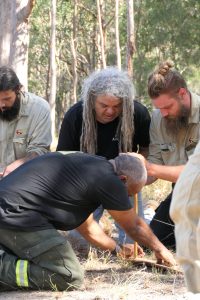
Because this doesn’t stop at a fence line.
Fire doesn’t recognise property boundaries. Neither do invasive species, or wildlife, or the broader pressures of a changing climate. To care for landscapes—and keep them resilient, functional, and healthy—requires coordination that matches landscape scale. We need collaborative relationships and shared understanding as we work together towards the same outcomes.
Where the soft ash lands, it won’t stay for long. The next rain will press it into the soil, feeding what comes next—grasses, seedlings, the slow return of a more open forest. In time, the mosaic will soften, edges will blur, and fuel will begin to build again.
Fire will come back.
The difference is whether it arrives on its own terms, or on ours.
Here, today, fire moved slowly enough to walk beside: low, deliberate, guided, understood, and shared. Not something to fear or exclude, but something to work with.
Because this landscape has always known fire.
And if we are willing to work together—to listen, to learn, and to act across the lines we’ve drawn on maps—it can move like this again.